Flatbed EV recovery
All four wheels off the road, which is what almost every manufacturer requires.
Out of charge, will not wake up, or stopped mid-journey? Electric cars have to travel on a flatbed. We recover EVs and hybrids through our service network, 24 hours a day.
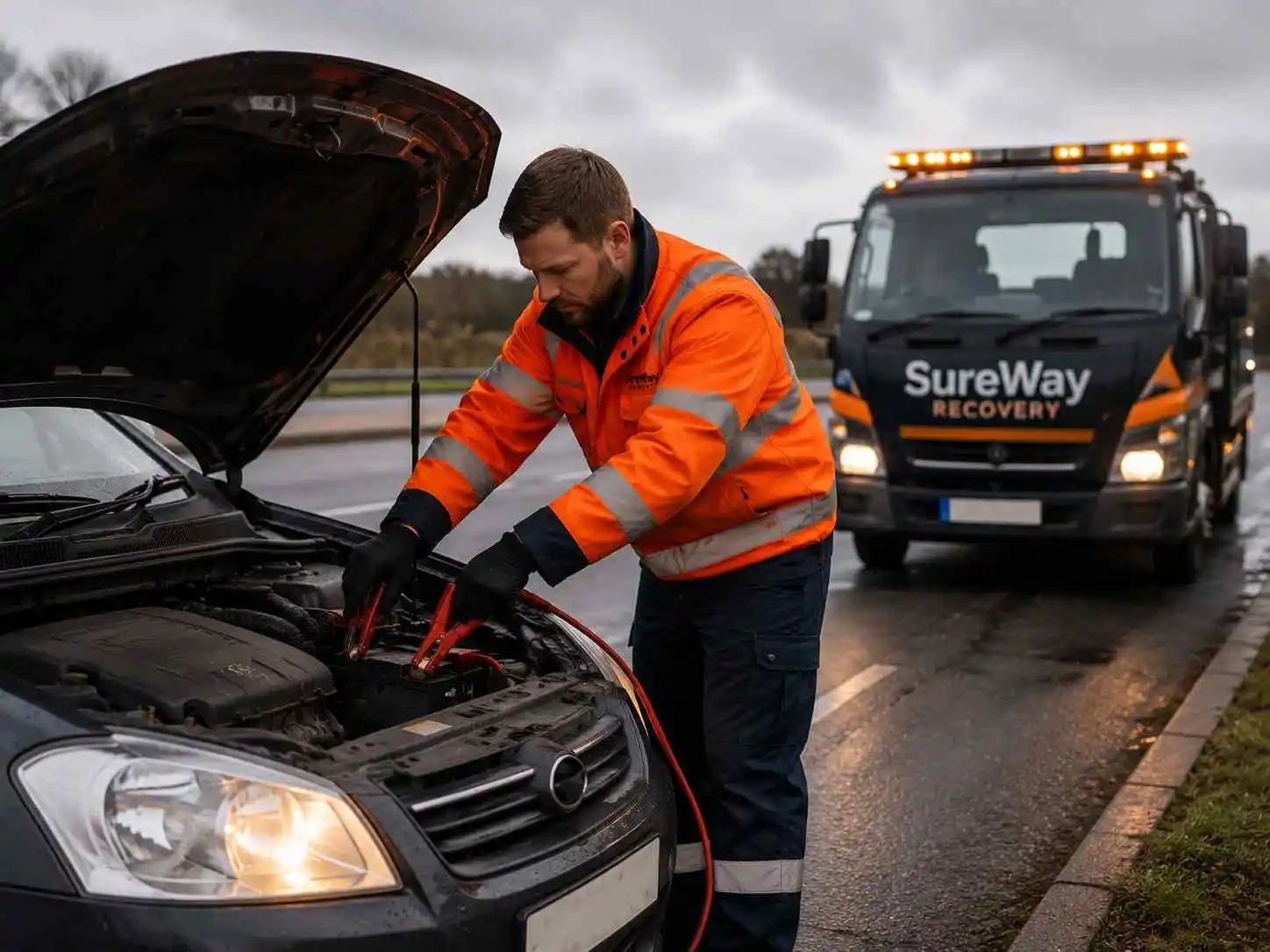
SureWay recovers electric cars on a flatbed through our service network, 24 hours a day. An EV must not be towed with its driven wheels turning on the road, because that spins the motor as a generator and can damage the drive unit. Flatbed transport, with all four wheels off the road, is the method almost every manufacturer requires.
A conventional tow lifts one axle and lets the other roll along the road. On an electric car those rolling wheels are usually connected directly to the motor, and turning them makes the motor act as a generator. That pushes current back into a system that is not expecting it, and it can damage the drive unit or the inverter. Nearly every EV handbook says the same thing in different words: transport on a flatbed, with all four wheels clear of the road.
If you can see smoke, smell something sharp and chemical, hear hissing or popping from under the car, or the battery pack has been struck in a collision, get everyone well clear and call 999. A damaged traction battery can reignite hours after an incident. We will not move a vehicle showing those signs until the fire service has confirmed it is safe to do so.
24/7 support through our service network.
Every call starts with your location, vehicle condition, clear pricing and the safest next step.
All four wheels off the road, which is what almost every manufacturer requires.
Running flat between chargers, with transport to a working charge point or your destination.
When the unit at the services or the car park will not deliver a charge.
A flat 12V battery can leave the car unresponsive even with plenty left in the traction pack.
The same flatbed rule applies, because the drive wheels are still connected to a motor.
Damaged electric vehicles moved once the scene has been made safe.
Give us the make, model and roughly how much range is left.
We send a vehicle that can carry the car with all four wheels off the road.
The car goes onto the bed under its own power or by winch, then is strapped at the wheels rather than the body.
No wheel turns on the road, so the motor is never back-driven.
To a working rapid charger, your home, or the garage you choose.
SureWay provides car recovery, towing and roadside assistance for motorways, A-roads, city streets, town roads and rural routes.
Range anxiety is rarely the problem. Running out usually happens because a charger was down, occupied, or further away than the car estimated.
Long gaps between working rapid chargers can catch drivers out, especially when a planned charging stop is unavailable or the car uses more energy than expected in cold weather.
A working charger that is occupied is the same problem as a broken one when you have twelve miles of range left. If waiting is not realistic, we can move the car to a free unit or straight to your destination.
Business parks and city-centre workplaces can have limited or fully occupied charging spaces. If waiting is not practical, we can recover the vehicle to a suitable charger or destination.
A cold traction battery holds less usable charge and the car spends energy warming itself before it moves. A journey that was comfortable in September can fall short in January on the same route.
No. A normal tow leaves one axle rolling on the road, and on an EV those wheels are usually connected to the motor. Turning them makes the motor generate current, which can damage the drive unit or inverter. Almost every manufacturer specifies flatbed transport instead.
A dolly is not a safe substitute on most electric cars. It lifts one axle but still leaves the other turning, which is exactly the situation the handbook warns against. Unless the manufacturer explicitly permits it for that model, we use a flatbed.
We load it on the flatbed and take it to the most useful destination: a working rapid charger, your home charge point, or your chosen drop-off point. Roadside charging is not practical for most vehicles, so moving the car to power is usually faster than bringing power to the car.
Yes. Full hybrids and plug-in hybrids still have a motor connected to the drive wheels, so the same rule applies. If in doubt we default to the flatbed, because it is safe for every drivetrain.
No, and it is a common mix-up. Electric cars still have a small 12V battery that runs the locks, screens and control systems. If it dies the car can seem completely dead even with a full traction battery. That is often fixable at the roadside.
Treat it as an emergency. Get clear of the vehicle and call 999. A damaged traction battery can go into thermal runaway and reignite long after the impact. We recover the vehicle once the fire service confirms the scene is safe, and we tell the receiving site that the pack has been damaged.
Use these internal links to find related recovery, towing and roadside help.
Tell us where you are and we'll send the nearest recovery team with a clear arrival time and a fixed price before we start.